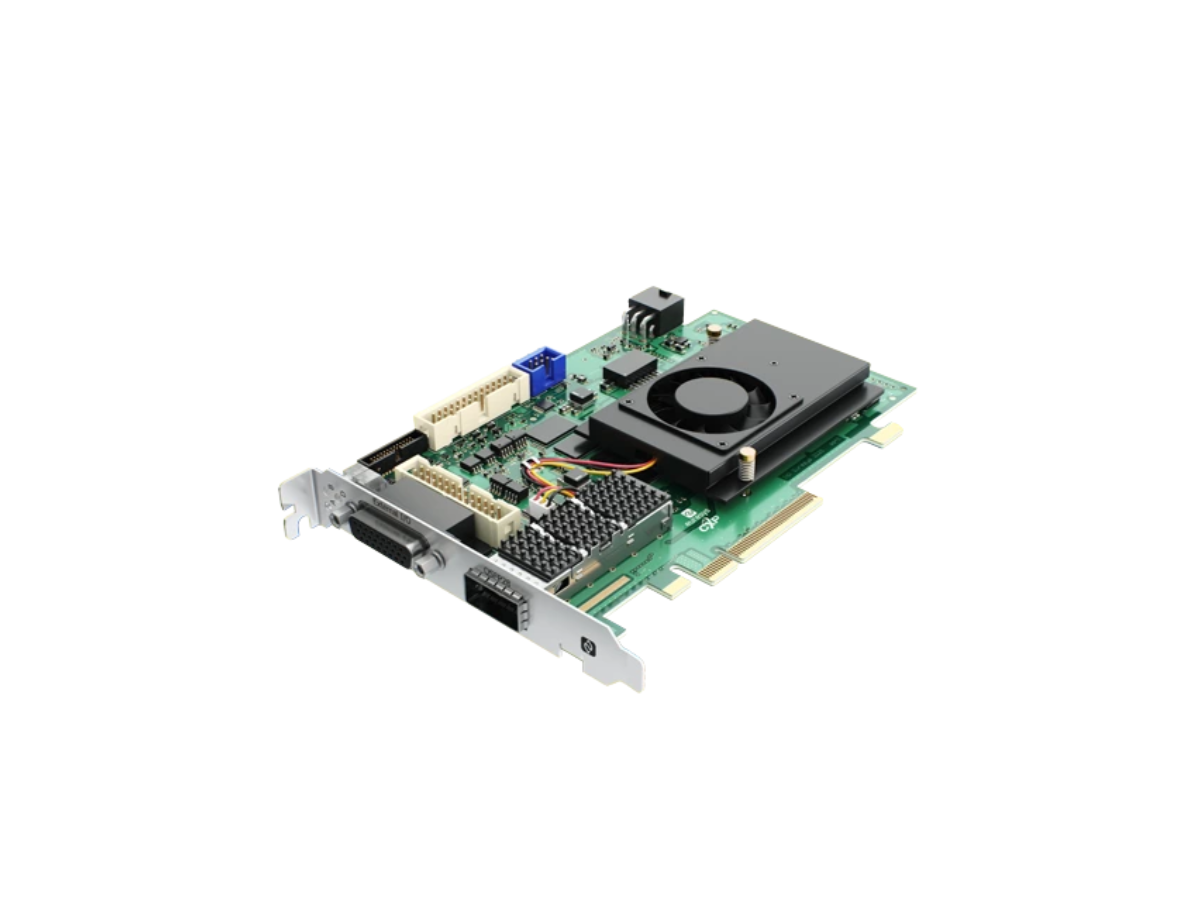
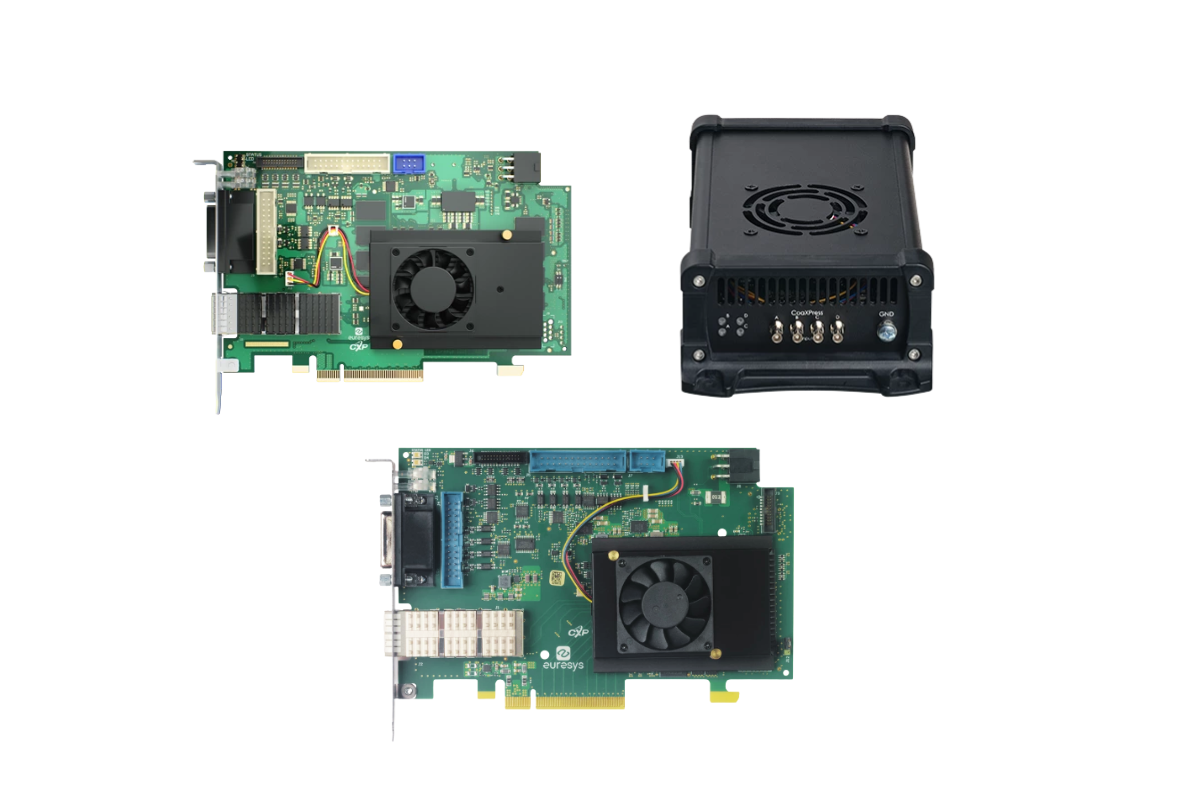
Euresys CoaXPress over Fiber frame grabber images

Top-tier Performance and Connectivity Using Fibre-Optic Instrastructure

The Euresys CoaXPress-over-Fiber frame grabbers are light but significant extensions of the CoaXPress solutions, designed to deliver top-tier performance and connectivity. By extending the proven CoaXPress protocol onto fibre-optic infrastructure, these solutions allow for improved resolution, throughput and cable-length boundaries while maintaining the low latency and deterministic behavior that vision-systems demand. 

With the CoaXPress-over-Fiber extension, you get all the reliability and performance of the CoaXPress protocol including ultra-high data rates, low jitter and minimal host CPU overhead, while benefitting from the scalability, reach and noise immunity of fibre-optic connectivity. 


Whether your workflow requires very long cable runs, high-resolution sensors, high frame-rates or electrically noisy environments, this technology creates a next-level foundation for industrial vision systems.

Euresys coaxlink QSFP28 frame grabber top side view

Coaxlink QSFP28: 100G Frame Grabber

The Euresys Coaxlink QSFP28 is a cutting-edge frame grabber built for the most demanding machine-vision applications, offering an industry-leading 100 Gbps of camera bandwidth via a single QSFP28-rated optical port. 

With support for four simultaneous 25 Gbps CoaXPress‑over‑Fiber links and a host interface of PCIe 4.0 ×8, this card enables seamless, ultra-high-throughput image acquisition from the latest high-resolution or high-frame-rate sensors in complex vision systems.

Euresys coaxlink QSFP+ frame grabber top side view

Coaxlink QSFP+: 4 Connection Frame Grabber

The Euresys Coaxlink QSFP+ is a high-performance frame grabber designed for demanding machine-vision systems that require high bandwidth and long-reach connectivity. With a single QSFP+ port compliant with 40 Gbps optical modules and a sustained camera bandwidth of up to 5,000 MB/s, this card enables acquisition from high-speed area-scan or line-scan cameras with reduced latency and minimal host CPU load.


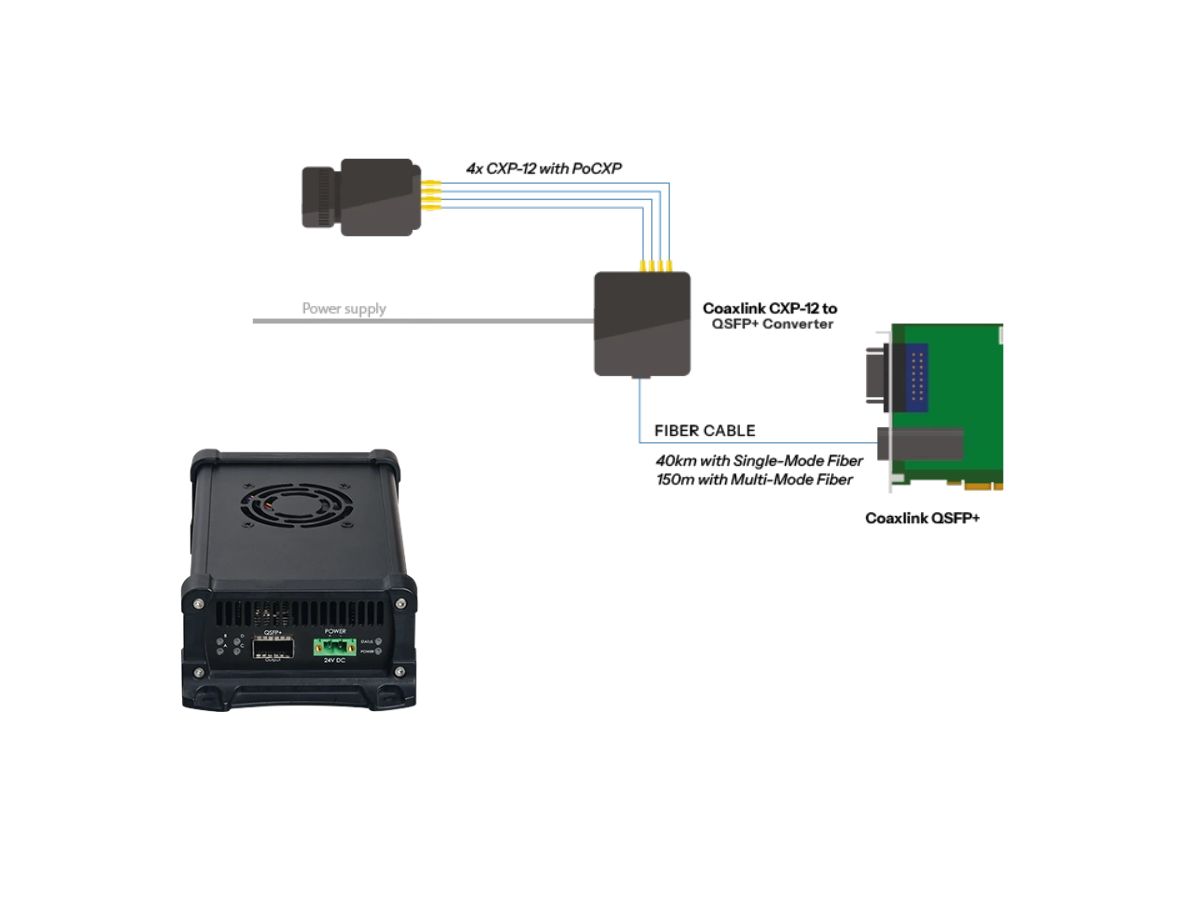
Euresys Coaxlink CXP-12 to QSFP+ Converter with graphic showing connection diagram between CXP-12 camera and Coaxlink QSDP+ frame grabber

Coaxlink CXP-12 to QSFP+ Converter

The Euresys Coaxlink CXP-12 to QSFP+ Converter is a powerful bridge device engineered to extend and enhance high-bandwidth imaging systems. It enables seamless integration between a CXP-12 camera interface and a CoaXPress-over-fiber host link, providing four Micro-BNC CXP-12 inputs on the camera side and a single QSFP+ optical link on the frame-grabber side. With support for up to 5,000 MB/s of aggregated camera bandwidth and PoCXP (Power over CoaXPress) capability, the converter ensures robust, high-performance signal acquisition and transmission in demanding machine-vision environments.

CoaXPress-over-Fiber Key Features:

  • Native CoaXPress protocol over fibre optics — no protocol conversion required
  • Multi-10 Gbps (and beyond) bandwidth: the initial configuration supports 4 × 10 Gbps for a total ~40 Gbps per camera, with upgrade paths to 4 × 25 Gbps (100 Gbps) and 4×50 Gbps (200 Gbps)
  • Standard Ethernet-fibre optics connectors (SFP+/QSFP+/QSFP28) and cable infrastructure means lower cost and access to mature ecosystem
  • Very long cable reach: multi-mode fibre up to ~150 m or single-mode fibre up to ~40 km (depending on module) when using CoaXPress-over-Fiber connectivity
  • Low latency, low jitter image acquisition with dedicated hardware handling packet management rather than relying on general‐purpose NICs
  • Broad OS and GenICam compatibility: supports Windows, Linux, macOS and/or embedded systems; full GenICam standard feature naming convention (SFNC) support
  • Robust industrial-grade design: high-performance DMA, extensive camera control functions, digital I/O lines, and event logging tools (such as the “Memento” logging tool) available
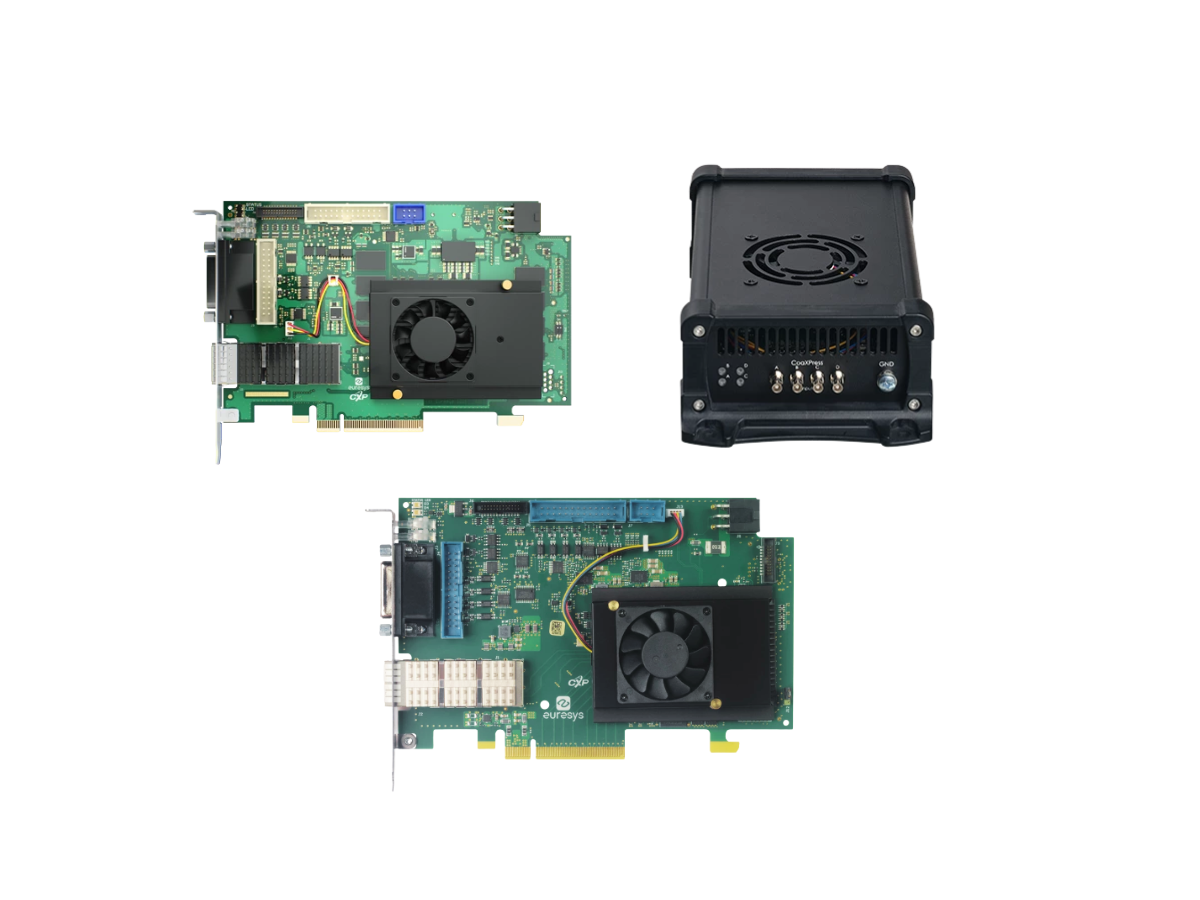
Euresys CoaXPress over Fiber frame grabber images

Ideal Solution For:

  • High-speed automated optical inspection (AOI) systems in electronics manufacturing
  • Semiconductor and solar-cell manufacturing
  • Printing and packaging inspection
  • Transportation, logistics and large-scale vision installations
  • Advanced surveillance/recording applications requiring high bandwidth
  • Harsh or remote industrial environments